
The Jarque-Bera test is used to check hypothesis about the fact that a given sample xS is a sample of normal random variable with unknown mean and dispersion. As a rule, this test is applied before using methods of parametric statistics which require distribution normality.
This test is based on the fact that skewness and kurtosis of normal distribution equal zero. Therefore, the absolute value of these parameters could be a measure of deviation of the distribution from normal. Using the sample Jarque-Bera statistic is calculated:
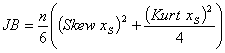
(here n is a size of sample), then p-value is computed using a table of distribution quantiles. It should be noted that as n increases, JB-statistic converges to chi-square distribution with two degrees of freedom, so sometimes in practice table of chi-square distribution quantiles is used. However, this is a mistake - convergence is too slow and irregular.
For example, even if n = 70 (which is rather big value) and having JB = 5 chi-square distribution quantiles gives us p-value p = 0.08, whereas real p-value equals 0.045. So, we can accept the wrong hypothesis. Therefore it's better to use the specially created table of Jarque-Bera distribution quantiles.
To create this table, the Monte-Carlo method was used. The program in C++ had generated 3600000 samples of n normal numbers (at that, a high-quality random number generator was used). Having these samples 3600000 values JB(xS) were calculated. These values were used to construct tables of quantiles for given n. This was done for each n from {5, 6, 7, ..., 198, 199, 200, 201, 251, 301, 351, ..., 1901, 1951} . Total calculation time was several tens of machine hours.
The table created was too big (2.5 Mb in binary format), so the following step was to compress it: JB(xS) distribution for the key n was saved using piecewise-polynomial approximation, intermediate values are found using interpolation. For n > 1401 asymptotic approximation is used.
We think that the approximation table is good enough for practice needs. You can find relative errors for different p-values in the following table:
p-value		   relative error (5≤N≤1951)
[1, 0.1]            < 1%
[0.1, 0.01]         < 2%
[0.01, 0.001]       < 6%
[0.001, 0]          wasn't measured
We should note that the most accurate p-values belong to interval [0, 0.01]. This interval is used to make a decision most often. Accuracy decreasing in [0.01, 0.001] is determined by the fact that the less p-value, the less probability to get it if a null hypothesis is accepted, and the more tests are required to find the corresponding distribution quantile.
To calculate p-values in interval [0.001, 0] asymptotic approximation is used. The author believes that this method allows us to get credible results in a reasonable interval. The quality of such approximation wasn't measured because of the considerable machine time required to perform such measurement.
This article is licensed for personal use only.
ALGLIB Project offers you two editions of ALGLIB:
ALGLIB Free Edition:
+delivered for free
+offers full set of numerical functionality
+extensive algorithmic optimizations
-no multithreading
-non-commercial license
ALGLIB Commercial Edition:
+flexible pricing
+offers full set of numerical functionality
+extensive algorithmic optimizations
+high performance (SMP, SIMD)
+commercial license with support plan
Links to download sections for Free and Commercial editions can be found below:


