Sometimes, it is required to solve the following problem: having matrix A which we have already inverted (and got A-1). Then, we have changed some elements of A, and we need to invert the matrix modified as follows.
Of course, this problem can generally be solved by inverting the modified matrix. However, there is a more effective way which takes into account the fact that we already have A-1 and the input matrix was modified slightly.
The Sherman-Morrison formula serves as the basis of an algorithm:
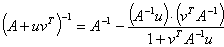
Here A is a square NxN matrix whose inverse matrix we know, u and v are the columns of height N defining the matrix modification, (uivj is added to ai,j). We can see that the inverse matrix update with this formula requires N2 operations with real numbers, which is N times better than the inversion by using a general algorithm.
Depending on u and v, there are different types of matrix A modifications and matrix A-1 update with different time complexity. Let's consider the main cases:
These cases have a different computational complexity. The fastest is an inverse matrix update where only one element of the source matrix is changed. We'll take it as a unit. The inverse matrix update by row or column is only 2 times slower (thus, if three or more elements of one row or column were modified, it would better to use this algorithm than the previous one). The inverse matrix update with arbitrary vectors u and v is three times slower than the simple update.
Note #1
The algorithm stability is in question. At least, one step is stable enough if A and B are well-conditioned.
The module contains several subroutines which update A-1 both in the general case and in the special cases described above.
The RMatrixInvUpdateSimple subroutine updates A-1 when adding UpdVal to the matrix element located in row UpdRow and column UpdColumn.
The subroutines RMatrixInvUpdateRow and RMatrixInvUpdateColumn update the matrix when adding a vector to the matrix row or column.
The subroutine RMatrixInvUpdateUV updates an inverse matrix in the general case which is defined by vectors U and V.
This article is licensed for personal use only.
ALGLIB Project offers you two editions of ALGLIB:
ALGLIB Free Edition:
+delivered for free
+offers full set of numerical functionality
+extensive algorithmic optimizations
-no multithreading
-non-commercial license
ALGLIB Commercial Edition:
+flexible pricing
+offers full set of numerical functionality
+extensive algorithmic optimizations
+high performance (SMP, SIMD)
+commercial license with support plan
Links to download sections for Free and Commercial editions can be found below:


