LDLT-decomposition is a generalization of for symmetric matrices which are not positive definite. As opposed to Cholesky decomposition, which exists only for symmetric positive definite matrices, LDLT-decomposition exists for each symmetric matrix.
LDLT-decomposition of the matrix A is a decomposition of the form A = L·D·L·T or A = U·D·U·T. There are two differences compared to Cholesky decomposition. First, matrix D is used. D is a block-diagonal matrix with blocks 1x1 or 2x2. Secondly, the matrices L and U are not triangular matrices, but products of triangular matrices and permutation matrices:
L = P1L1·...·PkLk·... U = PnLn·...·PkLk·...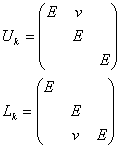
Here v is a column. Its width s is equal to the width of the diagonal block number k in matrix D (1 or 2), its height is equal to k-s for matrix Uk, n-k-s+1 for matrix Lk.
We can see that the LDLT-decomposition structure is much more complex than the structure of Cholesky decomposition or LU-decomposition, but this decomposition allows to factorize any symmetric matrix (as opposed to Cholesky decomposition) and it is faster than more general LU-decomposition. It should be noted that the LDLT-decomposition is faster than the LU-decomposition but slower than the Cholesky decomposition, so it is recommended to use the latter whenever possible.
The matrix decomposition is performed by subroutine SMatrixLDLT, which gets the upper or lower triangle of matrix A as an input and replaces it with matrices L and D which are stored in compact form (it is described in the program's comments).
Algorithms of matrix inversion and solving systems of linear equations work with matrices in compact form and don't use matrices L and U, so there is no subroutine to "unpack" them. A detailed description of the structure of matrices L and U can be found in the program's comments, so, if necessary, you can unpack these matrices on your own.
This algorithm is transferred from the LAPACK library.
This article is licensed for personal use only.
ALGLIB Project offers you two editions of ALGLIB:
ALGLIB Free Edition:
+delivered for free
+offers full set of numerical functionality
+extensive algorithmic optimizations
-no multithreading
-non-commercial license
ALGLIB Commercial Edition:
+flexible pricing
+offers full set of numerical functionality
+extensive algorithmic optimizations
+high performance (SMP, SIMD)
+commercial license with support plan
Links to download sections for Free and Commercial editions can be found below:


